
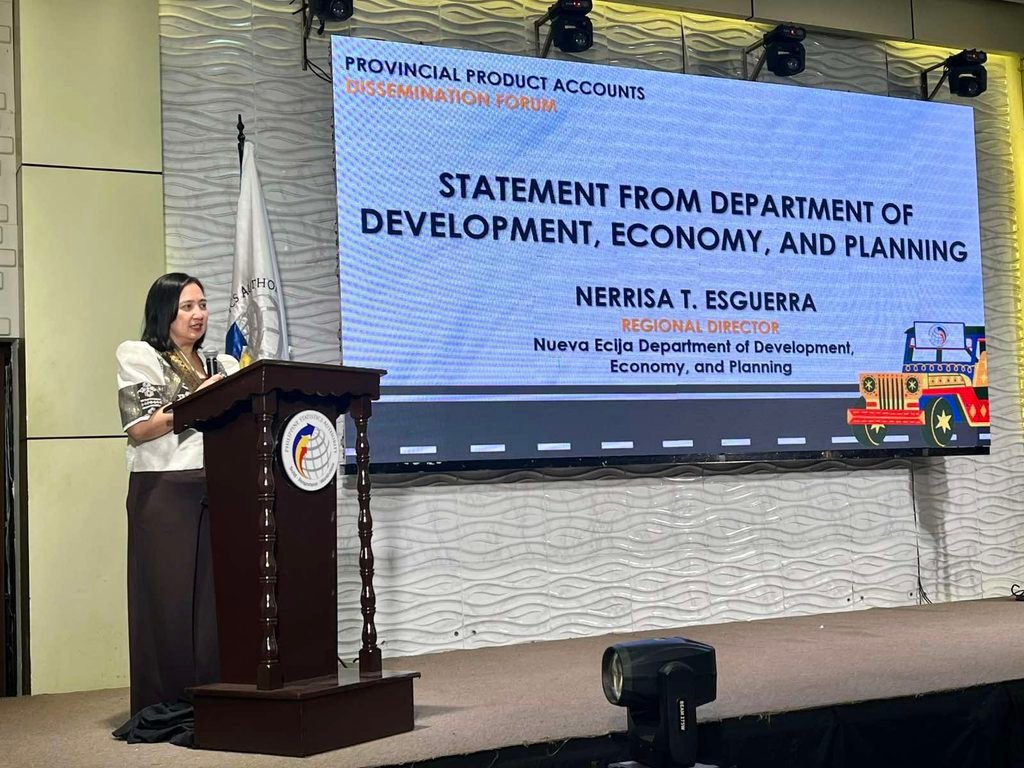
SANTA ROSA, Nueva Ecija (PIA) — Central Luzon’s economy showed resilience amid the challenges faced in 2025, posting continued growth across key sectors, according to the Department of Economy, Planning, and Development (DEPDev).
During the Provincial Product Accounts Dissemination Forum in Santa Rosa, Nueva Ecija, DEPDev Regional Director Nerrisa Esguerra cited Philippine Statistics Authority data showing that Central Luzon’s economy grew by 4.5 percent in 2025, comparable to the national growth rate of 4.4 percent.
Esguerra underscored that most provinces and highly urbanized cities contributed to the regional growth, with Pampanga, Nueva Ecija, and Bulacan as the largest contributors.
Nueva Ecija posted a 7-percent growth rate, the fastest among economies in the region, while Tarlac and Pampanga also outpaced the national and regional growth rates.
“Pinapakita ng mga resultang ito ang patuloy na sigla at katatagan ng ating mga lokal na ekonomiya sa kabila ng mga hamong kinaharap noong 2025, kabilang ang pandaigdigang krisis sa langis, mga sakuna, at mga isyu ng korapsyon,” she said.
Esguerra noted that the region’s agriculture, forestry, and fisheries (AFF) sector recovered from a 0.4-percent contraction in 2024 to a 3.9-percent expansion in 2025, supported by increases in palay, livestock, poultry, and fisheries production.
Tarlac, Nueva Ecija, and Bulacan accounted for nearly two-thirds of the region’s agricultural output, with Nueva Ecija among the region’s top agricultural producers.
However, Esguerra pointed out that agricultural output remains below its pre-pandemic level, while farmers and fisherfolk continue to face risks from adverse weather, flooding, animal diseases, and other production challenges.
Given these challenges, she emphasized the need for continued investments in farm mechanization, climate-resilient technologies, irrigation systems, post-harvest facilities, and stronger value chain linkages to translate agricultural growth into sustained gains, income, employment, and food security.
The industry sector, meanwhile, grew by 2.3 percent in 2025 and accounted for 41.8 percent of the regional economy, with manufacturing, construction, utilities, and mining and quarrying all recording growth.
Bulacan and Pampanga collectively accounted for more than half of the region’s industry output.
Esguerra said the region must continue attracting investments that generate quality jobs, deepen local supply chains, and promote innovation to enhance industrial competitiveness.
She also stressed the need for government agencies and local government units (LGUs) to work together to reduce the cost of doing business, improve regulatory efficiency, accelerate digitalization, and ensure the timely delivery of strategic infrastructure projects.
The services sector, for its part, remained the largest contributor to the regional economy in 2025, accounting for 48.2 percent of total output and growing by 6.5 percent to approximately ₱1.24 trillion.
Pampanga, Bulacan, and Nueva Ecija made substantial contributions to the sector’s growth, driven mainly by wholesale and retail trade, education, real estate, transportation, and other service activities.
As the economy becomes increasingly digital and knowledge-driven, Esguerra underscored the need to invest in digital infrastructure, workforce development, and technological innovation.
She likewise highlighted the importance of helping micro, small, and medium enterprises (MSMEs), which comprise more than 99 percent of enterprises, participate in digital markets and integrate more effectively into regional and global value chains.
Looking ahead, Esguerra identified climate resilience, agriculture modernization, high-value industries, MSME productivity, digital transformation, workforce upskilling and reskilling, and strategic infrastructure and logistics as key areas for continued attention.
She further emphasized the role of LGUs in translating national and regional development plans into programs and projects, noting that local governments serve as important touchpoints for citizens, businesses, investors, and government agencies.
Esguerra reiterated DEPDev’s commitment to assisting LGUs in development planning, investment programming, and monitoring.
Through the Regional Development Council, DEPDev hopes to strengthen subnational governance toward achieving the goals of the Central Luzon Regional Development Plan.
Overall, these efforts form part of the government’s broader work under the administration of President Ferdinand R. Marcos Jr. to sustain economic growth, create opportunities, and improve the delivery of development programs.