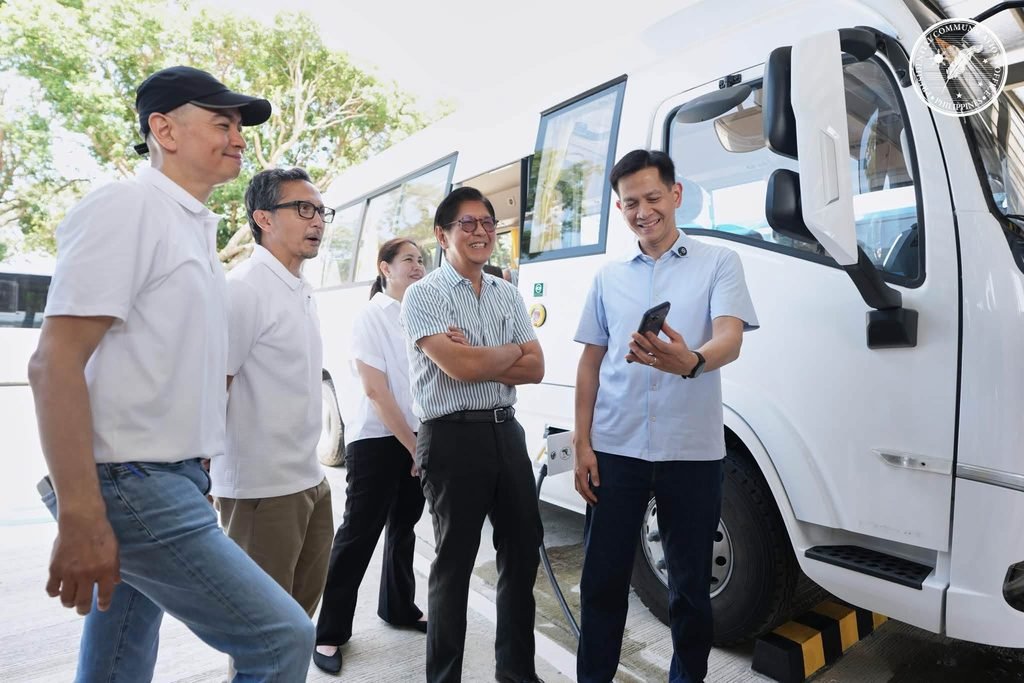
BALANGA CITY (PIA) — President Ferdinand R. Marcos Jr. inspected the newly completed Balanga Green Mobility Hub in Bataan on October 15, highlighting the government’s push to modernize public utility vehicles (PUVs) and expand sustainable transportation infrastructure across the country.
Marcos said the facility demonstrated the potential of electric mobility to lower operating costs for drivers and transport operators while making public transportation more affordable for commuters.
“Ngayon, ito na nga ang ating ikakalat sa buong Pilipinas. Nauna lang ito pero napakaganda kasi malaki ang magiging kita – mas malaki ang magiging kita ng ating mga nagpapasada at pati na para sa ating mga commuters,” Marcos said.
He added that fuel savings could help reduce transportation expenses and fares, while fully electric vehicles could eliminate tailpipe pollution.
“Walang pollution ang fully electrical. Walang pollution,” he said.
The President was accompanied by Department of Public Works and Highways (DPWH) Secretary Vince Dizon during the inspection of the facility in Barangay Cabog-Cabog, Balanga City, where the integrated terminal features renewable energy systems, battery storage and electric vehicle (EV) charging stations.
Marcos said the government had been pursuing PUV modernization since the beginning of his administration but had encountered challenges that required gradual solutions.
He thanked Bataan’s local leaders for advancing the project through cooperation between the local and national governments, particularly the DPWH and the provincial government.
“Ito ngayon ang bagong teknolohiya na gagawin natin para mas malaking maitutulong sa ating mga kababayan, sa mga nagpapasada, sa mga nag-o-operate, pati na sa ating mga commuter,” Marcos said.
The P100-million project, initiated as a priority infrastructure initiative by Bataan 2nd District Representative Albert Garcia, was funded through the General Appropriations Act, with P50 million allocated each for fiscal years 2025 and 2026.
Implemented by the DPWH Bataan 2nd District Engineering Office, the facility features 222 solar photovoltaic modules with an estimated generating capacity of 130.98 kilowatts-peak and two battery energy storage units with a combined nominal capacity of 432 kilowatt-hours.
It also houses four fast-charging units with a total charging capacity of 240 kilowatts (kW), or 60 kW per unit.
Its terminal facilities include four transport bays that can accommodate up to eight vehicles simultaneously, six designated spaces for public utility vehicles, passenger waiting lounges, dispatch facilities and administrative offices.
Dizon said the project reflected Marcos’ directive to build better infrastructure that met public needs and delivered value for taxpayers’ money.
“Build Better, tingnan niyo naman ang napakagandang charging station na ito, kahit ako hindi makapaniwala na DPWH ang gumawa nito na gobyerno ang gumawa nito. Pero ‘yun ang gusto ng Pangulo kailangan, deserve ng mga kababayan natin,” Dizon said.
He emphasized that the government should move away from substandard public infrastructure and deliver projects with better quality, completed on time and within budget.
Dizon also cited the potential savings for transport groups, bus and jeepney operators, and private citizens, adding that the administration intended to replicate similar projects nationwide.
“Ang laking bagay, ang laking kamurahan,” he said, referring to the savings that the facility could provide.
Governor Jose Enrique Garcia III welcomed the President’s visit to what he described as the province’s first Green Mobility Hub and thanked the national government for funding its construction through the DPWH.
“Masayang masaya po kami sa pagbisita ng Pangulo dito sa kauna-unahang Green Mobility Hub sa probinsiya ng Bataan,” Garcia said.
He said the provincial government appreciated the national government’s support for the terminal, which combined solar energy with battery-assisted charging facilities.
During the visit, Garcia and other provincial leaders presented Bataan’s green roadmap, which links renewable energy deployment with financing options for EVs for local transport operators.
Transport groups and drivers, identified as primary beneficiaries of the province’s green transport financing program, also attended the event.
The initiative aims to improve drivers’ livelihoods while reducing carbon emissions through sustainable public transportation.
Local government officials, municipal mayors, community leaders and private sector representatives also joined the inspection.
The Balanga Green Mobility Hub highlighted the national and local governments’ joint efforts to advance cleaner public transportation, lower operating costs for transport workers and improve mobility for commuters.
SOURCE Rick Quiambao PIA3