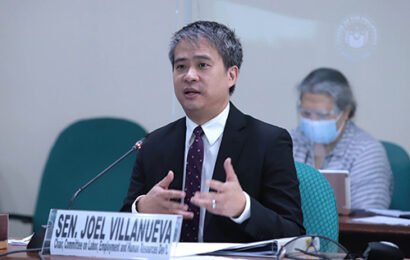
Senator Joel Villanueva is pressing the national government to mobilize full funding for earthquake recovery in Mindanao, as the death toll from last week’s magnitude 7.8 tremor continues to rise and tens of thousands remain displaced across four regions.
Villanueva filed proposed Senate Resolution No. 447 on Monday urging the government to “take all necessary measures to ensure the availability of adequate funding and resources for the relief, rehabilitation, reconstruction, and recovery of communities” hit by the June 8 quake.
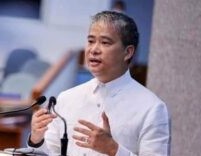
“Beyond the immediate humanitarian response, substantial resources will be required to restore damaged infrastructure, rehabilitate schools and hospitals, rebuild homes and communities, revive local economies, and support the recovery of affected families, workers, farmers, fisherfolk, and businesses,” Villanueva said.
“While existing disaster-response mechanisms provide immediate assistance during emergencies, the magnitude of the destruction and the scale of rehabilitation and reconstruction required may exceed currently available resources, thereby necessitating additional government support to ensure a timely, comprehensive, and sustainable recovery effort,” he continued.
The June 8 quake struck 32 kilometers offshore west of Maasim, Sarangani, along the Cotabato Trench.
At least 61 persons were killed while 33 remain missing and some 1,221 individuals were injured as of June 12, according to the Office of Civil Defense.
Data from the Department of Social Welfare and Development showed that 553,068 persons across four regions in Mindanao were affected. Of the total, some 9,393 persons were taking shelter at 26 operational evacuation centers run by the government while 54,274 individuals were staying outside evacuation centers with relatives or in makeshift arrangements, the agency’s June 12 monitoring report showed.
In General Santos City alone, initial damage assessments reached ₱1 billion, covering malls, hospitals, hotels, churches, banks, and the airport, according to estimates of the Department of Public Works and Highways. Total losses are still being tallied as assessment teams reach isolated communities.
Villanueva’s resolution warned of broader consequences if disruptions to Mindanao’s agriculture, fisheries, logistics, and commerce were not quickly addressed, noting that the island is a principal driver of the country’s food production and agricultural exports.
The measure also called for restoration of transportation systems, water and power infrastructure, schools, and health facilities, and urged the government to ensure that reconstruction be “resilient and climate-adaptive.”
“A swift and decisive government response is necessary not only to address the immediate needs of affected communities but also to prevent further economic dislocation, support local government units, protect national economic interests, and ensure that the people of Mindanao are able to recover and rebuild from the devastation caused by the earthquake,” Villanueva said.