For years, coastal communities in Balanga City lived with a growing sense of uncertainty. Floodwaters regularly threatened homes and fishponds during high tide, especially when accompanied by strong winds and storms. At the same time, fish catches declined as mangrove forests that once protected the coastline were cut down and degraded, making it harder for fishing families to earn a living.
Among those who witnessed these changes firsthand was Jaime Buenaventura, Chair of the City Fishery and Aquatic Resources Management Council (CFARMC).
“Noon, maraming nangangahoy at pumuputol ng mga bakhawan sa aming lugar. Kaya tuwing high tide, nagiging problema ito, lalo na kapag sinasabayan pa ng malakas na hangin dahil mas tumataas ang tubig. Sobrang kinakabahan po ako tuwing ganito ang nangyayari, at kapos din po kami sa nahuhuling isda,” he recalled. (“Before, many people would cut down and gather wood from our mangroves. Because of this, high tides became a problem for us, especially when accompanied by strong winds, which cause the water to rise even higher. I would get extremely worried, and we would also catch fewer fish.”)
Today, the story is markedly different.
Where degraded coastlines once exposed communities to flooding, thriving mangrove forests now serve as natural barriers against strong waves, storm surges, and rising waters. The restored ecosystems help absorb and slow floodwaters before they reach communities while providing shelter and breeding grounds for fish and other marine species. As a result, local fishermen have seen improved fishery yields and more secure incomes.
Balanga’s experience reflects the national government’s broader push to strengthen climate resilience. In November 2024, President Ferdinand Marcos Jr. directed the Department of Environment and Natural Resources (DENR) and other government agencies to revise the country’s flood control masterplan to keep pace with increasingly intense storms and heavier rainfall. The President emphasized that existing flood control measures must adapt to changing climate conditions and increasing volumes of floodwater.
In support of this directive, the DENR has been advancing nature-based solutions (NbS), which harness the protective functions of ecosystems such as wetlands, rivers, and mangrove forests to complement conventional infrastructure and reduce climate-related risks.
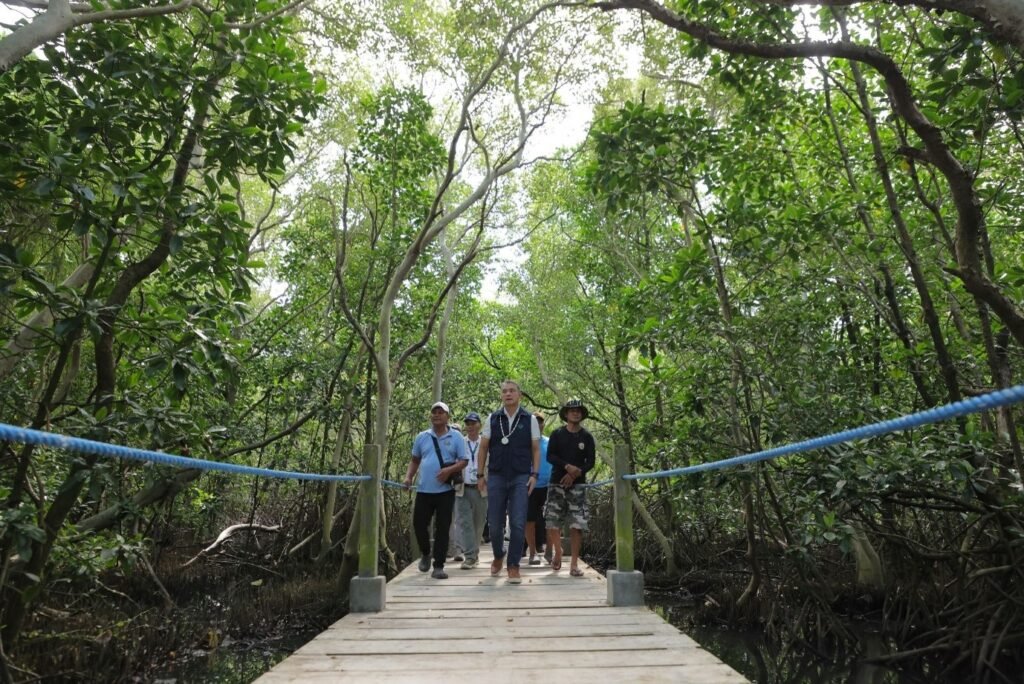
These efforts were highlighted during a site inspection of the Balanga Wetland and Nature Park led by Environment Secretary Juan Miguel “Mitch” T. Cuna, together with DENR regional officials, the city government headed by Mayor Raquel Garcia, and community representatives.
Secretary Cuna underscored the need to allow natural ecosystems to play a larger role in protecting communities from the impacts of climate change.
The DENR has supported the conservation and restoration of Balanga’s mangrove ecosystem through technical assistance, capacity-building activities, regular monitoring, and the deployment of River Rangers who help maintain waterways and protect coastal resources. The agency has also installed trash traps and waste interception systems to prevent floating waste from reaching sensitive mangrove and estuarine areas, helping improve water quality and reduce environmental degradation.
The success of the initiative has been driven largely by community participation. Local fishermen and volunteers helped plant and nurture mangroves along the coastline, transforming once-vulnerable areas into natural buffers against flooding and coastal erosion.
According to fisherman Benjie Manuel, the restored mangroves have helped shield the area from stronger waves brought by recent typhoons, reducing threats to nearby homes and fishponds. Just as important, the mangroves have revitalized local fisheries by providing nursery habitats for juvenile marine species before they move into open waters. He said fishermen’s incomes have more than doubled as fishery yields improved.
The benefits extend beyond fishing communities. Local seafood processor Armanda Battad said the mangroves help ensure a steady supply of raw materials from fishermen while also attracting visitors to the area, creating opportunities for tourism and local businesses.
Despite these gains, maintaining healthy wetlands and waterways remains an ongoing challenge. To help address pollution, River Rangers continue to conduct cleanups, maintain trash traps, and prevent waste from accumulating in rivers and mangrove areas, protecting both ecosystems and livelihoods.
For Manuel, the impact of these efforts is measured not only in improved incomes, but also in greater peace of mind.
“Laking pasasalamat namin na nakapagtanim kami ng bakawan na naging depensa na sa palaisdaan, depensa pa sa mamamayan,” he said. (“We are grateful that we were able to plant mangroves, which have become a defense not only for our fishponds but also for our communities.”) As the Philippines strengthens its approach to climate resilience under President Marcos’ directive to improve flood management, Balanga City’s experience demonstrates how nature-based solutions can protect communities from flooding while sustaining livelihoods and biodiversity. By investing in mangroves and wetlands, the city shows that working with nature can deliver lasting benefits for both people and the environment.