Representative Brian Poe of the FPJ Panday Bayanihan Party-list urged a decisive shift toward renewable energy, circular economy reforms, and inclusive workforce transformation during his keynote at the Philippine Democracy Series 2026 at the London School of Economics on March 23.
Speaking before members of the LSE Students’ Union Filipino Society and academic guests, including Professor Hyun Bang Shin, Head of the Department of Geography and Environment and Chair of the Segment, Poe emphasized that climate change is an immediate reality for Filipinos.
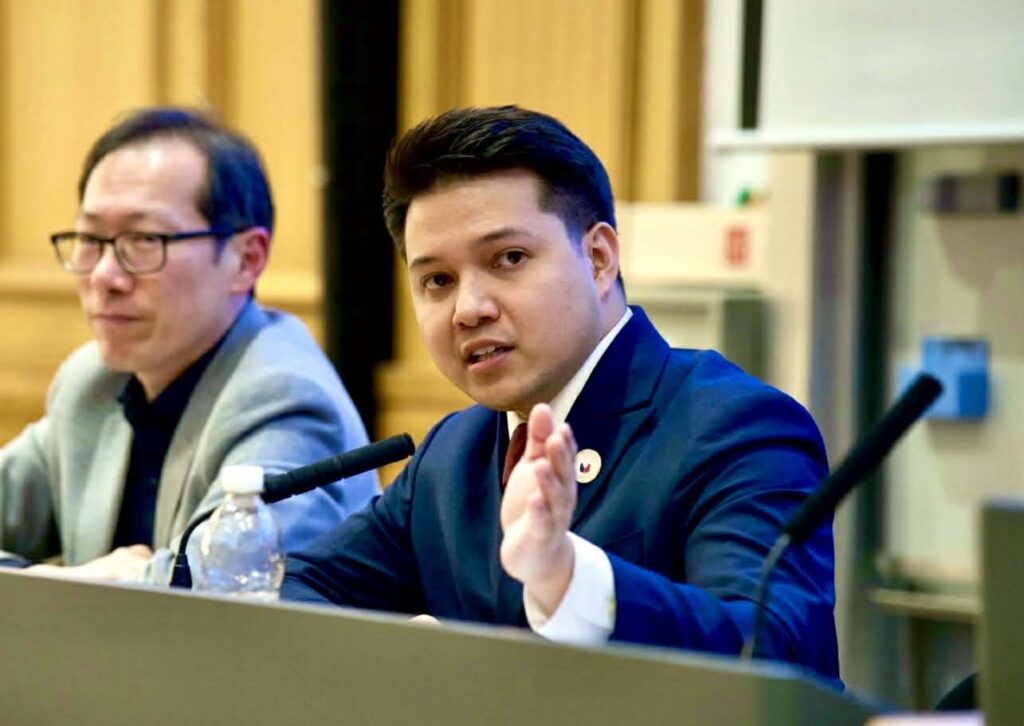
“It’s easy to view climate change as a line item on a balance sheet… But for us Filipinos, we don’t have that luxury. We actually have to pivot our lens from the global to the local.”
Poe called for a decisive shift toward renewable energy, circular economy reforms, and an inclusive workforce transition, stressing that clean energy is not only an environmental necessity but a sound economic strategy.
He warned of severe climate impacts: up to 11 million Filipinos could face extreme heat by 2030, rising to 74 million by 2050, while 150,000 may be permanently displaced by 2040. Economic losses could reach ₱466 billion by 2030, with climate-related damages projected at 7.6% of GDP—potentially climbing to 18–25% by mid-century.
Poe underscored the urgency of preparing workers for an AI-driven economy, citing the potential creation of 300,000 green jobs and ₱5.8 trillion in renewable energy investments.
“These are not just numbers—this is a human crisis. Struggling farmers, communities without development, and people forced to live in at-risk areas—this is the reality behind the data.”
Poe highlighted that transitioning to renewable energy is not just an environmental choice—it is the no-regrets choice in economic strategy that addresses most pressing national vulnerabilities.
“CHED and DepEd can’t pivot fast enough… But Technical Education and Skills Development Authority (TESDA) , because it’s technical and vocational, is able to pivot quickly to what jobs are available—and if we fund it enough, we’ll be able to create more jobs and more opportunities for Filipinos,” said Poe.
Poe emphasized dignity in vocational work, drawing lessons from Singapore and Germany: “They didn’t say vocational programs were any less important than a four-year or postgraduate degree. Graduates worked for companies like Boeing or Google, proving that vocational pathways provide opportunity and dignity.”
On circular economy reforms, Poe called for structural changes to production and waste.
“We’re shifting the burden of sustainability from the consumer to the design table—products must be designed to last, to be recoverable, and to be recyclable from the very beginning.”
Closing his address, Poe called on Filipino students and the diaspora to actively contribute to policymaking and national development:
“You are not meant to just be observers… you are the architects of the future of our country.”
He urged stronger collaboration between government, industry, and citizens where he cited that reimagining development requires a whole-of-the-nation approach— a Bayanihan in the modern era.
The Philippine Democracy Series 2026 provided a platform to discuss urgent national challenges, demonstrating how renewable energy, circular economy reforms, and inclusive workforce transitions can shape a sustainable future for the Philippines.