SCIENCE CITY OF MUÑOZ (PIA) — The Philippine Rice Research Institute (PhilRice) is upgrading its digital farming tools to help local government units (LGUs) better support rice farmers and improve productivity in farming communities.
The upgraded platforms are part of the Scaling Modern and Adaptive Rice Technologies for Prosperous Farming Communities (SMART Farm) Program, which promotes modern and data-driven rice farming practices.
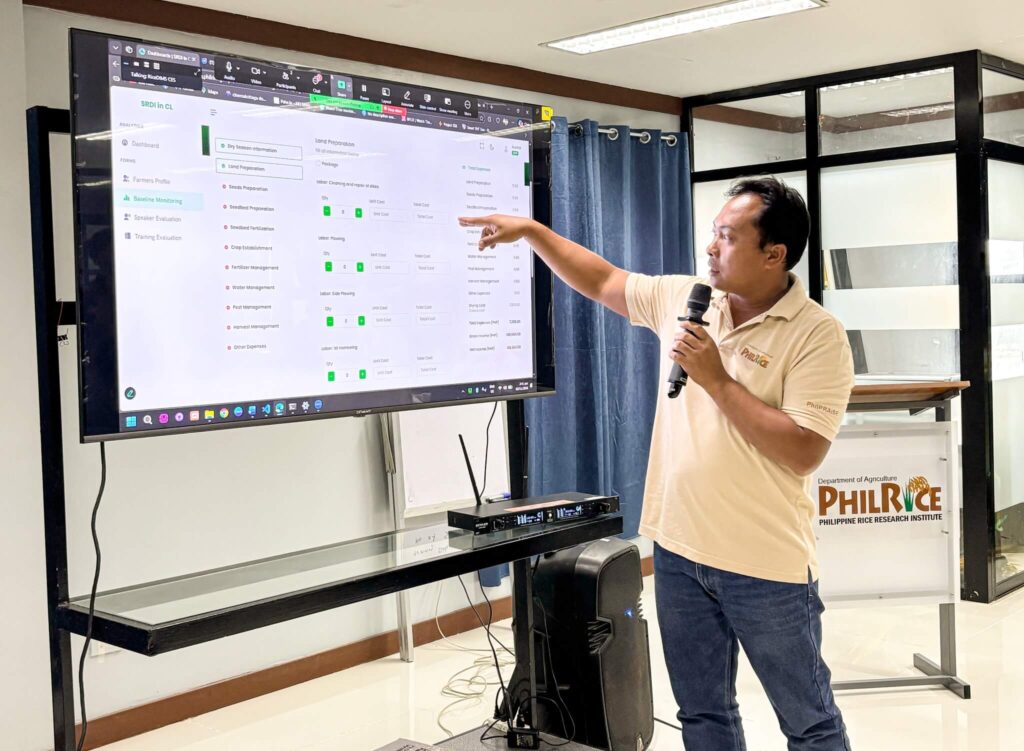
PhilRice SMART Farm Program lead Dindo King Donayre said the systems will help farmers and LGUs monitor farm activities, assess field conditions, and generate crop recommendations suited to local environments.
“These tools are being improved based on field feedback, which will support LGUs in helping farmers address yield gaps, limited machinery access, and climate risks,” he added.
Among the tools being improved are the PalayCheck App 2.0, the SMART-ICM Monitoring System, and the Scaling Rice Development Initiative Pest and Nutrient Management platform.
Developers are introducing new features such as offline access for field use, streamlined farmer registration, and enhanced data validation to improve the accuracy of farm records.
The advisory system is also being updated to enhance guidance on nutrient management by utilizing diagnostic tools like the Minus-One-Element Technique and the Leaf Color Chart.
According to Donayre, developers expect to complete the upgraded PalayCheck App and monitoring platform within the first quarter of the year, to support wider use by LGUs and agricultural technicians.
Meanwhile, field testing of recommended rice technologies is also expanding, such as direct-seeded rice using inbred varieties, which has been tested in 43 sites, while transplanted hybrid rice has been evaluated in 47 sites, each covering at least half a hectare.
Initial crop-cut estimates recorded yields of 8.56 tons per hectare for hybrid transplanted rice and 7.33 tons per hectare for inbred direct-seeded rice, showing the potential of these technologies to increase farm productivity.
PhilRice also reported that social media posts related to the technologies reached more than one million users in 2025, indicating growing online interest in the program.
Scaling activities are expected to reach 3,780 farmers, including a 30-hectare clustered pilot site where partnerships will help farmers access fertilizer and other essential farm inputs.
Through these upgraded digital tools and modern farming technologies, PhilRice aims to strengthen LGU support for farmers and promote more efficient and productive rice farming communities across the country.