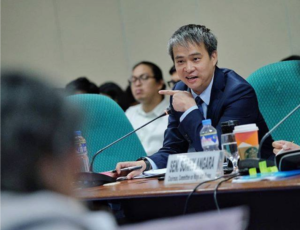
Senator Joel Villanueva filed a measure to amend and further strengthen Republic Act No. 9160 or the Anti-Money Laundering Act (AMLA) to combat financial crimes and protect the integrity of the financial system.
Villanueva’s Senate Bill No. 1983 seeks to give more teeth to the Anti-Money Laundering Council, expand the scope of covered persons, and update the predicate offense for money laundering.
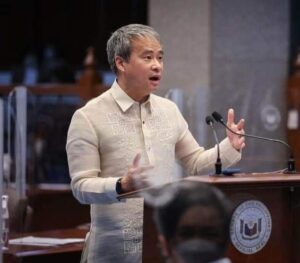
“Money talks, but dirty money whispers usually through complicit entities,” Villanueva, the chairperson of the Committee on Banks, Financial Institutions, and Currencies, said.
“We need a tougher law to catch up with the criminals trying to cover their illicit financial tracks,” he added.
Villanueva said the current law needs to respond to the evolving financial landscape, which now uses digital financial services, virtual assets, complex corporate set-ups, and cross-border financial transactions that present new vulnerabilities that may be exploited for money laundering and related activities.
He added that the Financial Action Task Force (FATF) continues to emphasize the need for stronger financial intelligence capabilities, effective supervision of covered entities, and swift enforcement mechanisms.
“Sustained reforms are necessary not only to maintain compliance with international standards, but also to safeguard the credibility and resilience of the Philippine financial system,” Villanueva said.
Under the bill, the range of entities subject to AMLA compliance requirements will be broadened to include trust and company service providers, lawyers and accountants engaged in specified financial transactions, online gambling operators, and virtual asset service providers.
The bill also sets an amount for cash transactions, which the AMLC may look into if going beyond limits.
The measure grants the Anti-Money Laundering Council (AMLC) stronger tools to detect and prevent illicit financial activities, including the authority to issue transaction suspension orders, administrative freeze orders, and subpoenas in the course of its investigation.
The list of predicate offenses for money laundering will also be expanded under the proposal to cover emerging crimes such as cybercrime, environmental offenses, agricultural economic sabotage, and offenses related to online sexual abuse anf exploitation of children.
The bill also seeks to enhance customer due diligence and reporting requirements for covered persons, while providing stronger administrative sanctions to ensure effective compliance with AMLA regulations.
According to the bill, the AMLC shall securely protect information received or processed by the body.
The proposed measure also aims to bolster the authority of the AMLC to suspend or freeze transactions by speeding up the process of filing a petition before the court, and keeping the 20-day period of the administrative order “effective until the Court of Appeals resolves the petition.”
It also proposed that the AMLC be authorized to retain and use the assets forfeited for the year,
provided that in no case shall the said annual appropriation exceed P150 million.
The said funds shall accrue to a trust fund to be managed and administered by the AMLC.
“We need a stronger Anti-Money Laundering law to protect the integrity of the economy. Above this, stopping money laundering goes beyond finance — it’s also about justice and accountability,” Villanueva said.