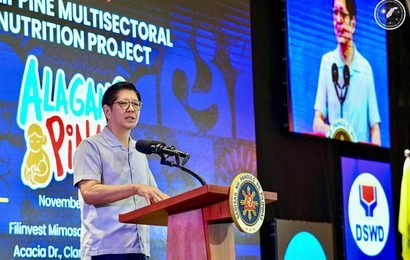
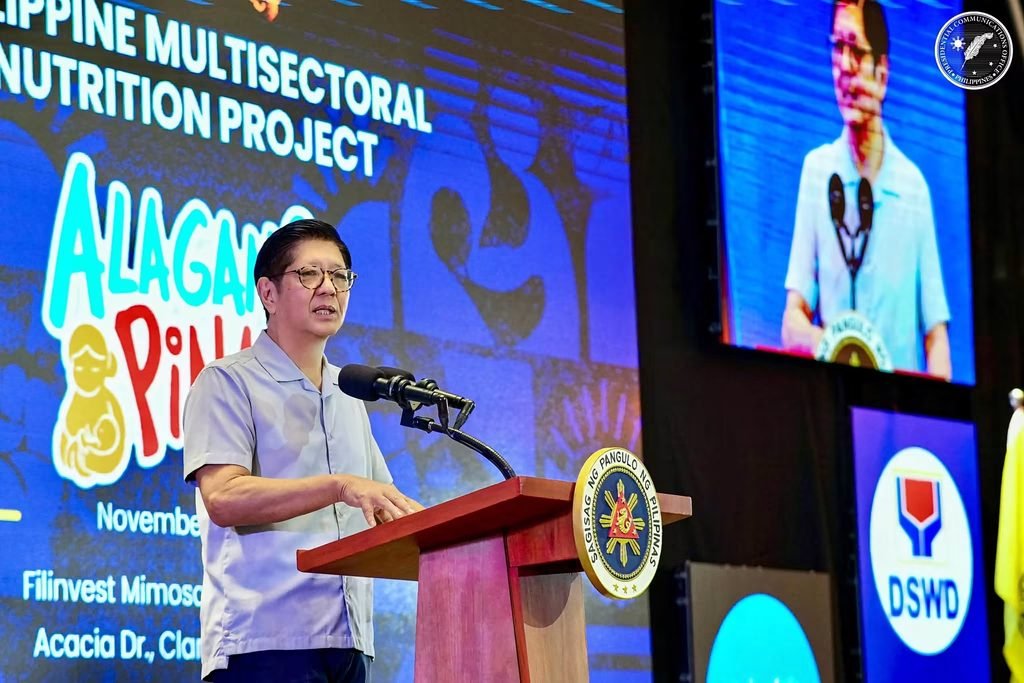
CLARK FREEPORT ZONE (PIA) — President Ferdinand R. Marcos Jr. has called for sustained government action to ensure that Filipino children receive proper nutrition during their first 1,000 days of life, stressing that this critical period shapes their growth and ability to learn.
Speaking at the Philippine Multisectoral Nutrition Project (PMNP) Alagang Pinas Summit 2026 in Clark Freeport Zone on November 25, Marcos emphasized the need to provide families with timely support, from pregnancy until a child’s second birthday.
“Ang wastong nutrisyon ay mahalaga sa paglaki at pag-unlad ng ating mga anak. Kaya nakasentro ang ating mga hakbang tungo sa early childhood nutrition, sapagkat ang unang 1,000 araw ay mahalaga sa paghubog ng paglaki at pagkatuto ng isang bata,” the President said.
He stressed that families should know where to seek assistance and what steps to take when they notice problems with their children’s growth.
Marcos said the government aims to sustain services established under the PMNP beyond the project’s implementation period to ensure that children who need nutritional assistance continue to receive appropriate and adequate care.
“Hindi dapat nakatali sa tagal ng isang proyekto ang ating serbisyo para sa kalusugan at kinabukasan ng bawat Pilipino,” he said, emphasizing that the services introduced through the project must become part of the government’s continuing work in communities.
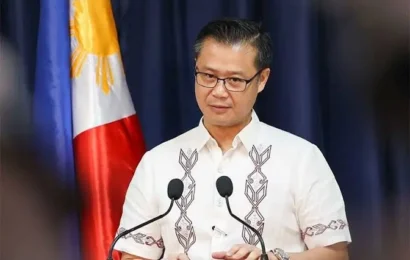
For his part, Health Secretary Edwin Mercado reported that 91.71 percent of pregnant women in participating areas completed iron-folic acid or multiple micronutrient supplementation, while 95.98 percent of infants under six months were exclusively breastfed.
“Covering 235 municipalities is a strong foundation, yet shifting the national stunting trend means closing remaining gaps and scaling up what works across those communities,” Mercado said.
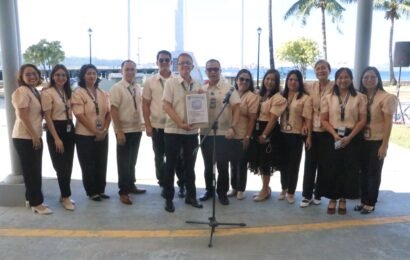
Marcos also underscored the need for a whole-of-government and whole-of-society approach, recognizing the contributions of national agencies, local government units (LGUs), development partners, health workers, nutrition scholars, and community volunteers.
He particularly recognized volunteers who regularly visit communities, monitor families, and relay information about their needs to local authorities, helping government identify concerns and respond promptly.
The President likewise highlighted the importance of national and local government coordination, noting that LGUs have firsthand knowledge of the conditions and needs of their constituents.
He said national government programs can only make a difference in people’s lives when local governments actively participate in their implementation.
The four-year PMNP, led by the Department of Health and the Department of Social Welfare and Development, brings together health, nutrition, water, sanitation, and early childhood interventions at the local level.
It culminates in the summit, which carries the theme “Alagang Pinas Tungo sa Mas Malusog na Bukas: Sustained First 1,000 Days (F1KD) Convergence.”
The summit also gives participating regions and LGUs an opportunity to present accomplishments, share effective practices, and identify ways to sustain nutrition interventions beyond the project’s implementation.
As of September 30, 2026, the project had reached 6.17 million beneficiaries in 235 participating municipalities and tracked and served around 549,000 children under five years old.
The Chief Executive also reported that 134 participating municipalities recorded significant reductions in stunting after two years of focused multisectoral interventions.
Despite these gains, he noted that malnutrition remains a serious concern, with around one in four Filipino children under five years old experiencing stunting in 2025.
He emphasized that addressing malnutrition requires more than providing adequate food, as families also need access to healthcare, clean water, sanitation, and other essential services.
The President cited the Philippine Plan of Action for Nutrition 2023–2028 as part of the government’s integrated response, alongside efforts to strengthen local implementation capacity, address financing constraints, and use nutrition data to guide decisions.
Marcos called on stakeholders to build on the project’s progress and maintain their commitment to improving children’s health and well-being.
“Our work is far from finished. But we have made progress, and it is now our responsibility to build on that progress,” he said.
The country’s efforts to address malnutrition also support the regional commitment of the Association of Southeast Asian Nations to end all forms of malnutrition through coordinated, multisectoral action, particularly in improving maternal and child nutrition.
Sustaining nutrition services beyond the PMNP’s implementation period remains essential to ensuring that mothers and young children continue to receive appropriate care and nutritional support during the first 1,000 days of life.
SOURCE: Rick Quiambao PIA3